
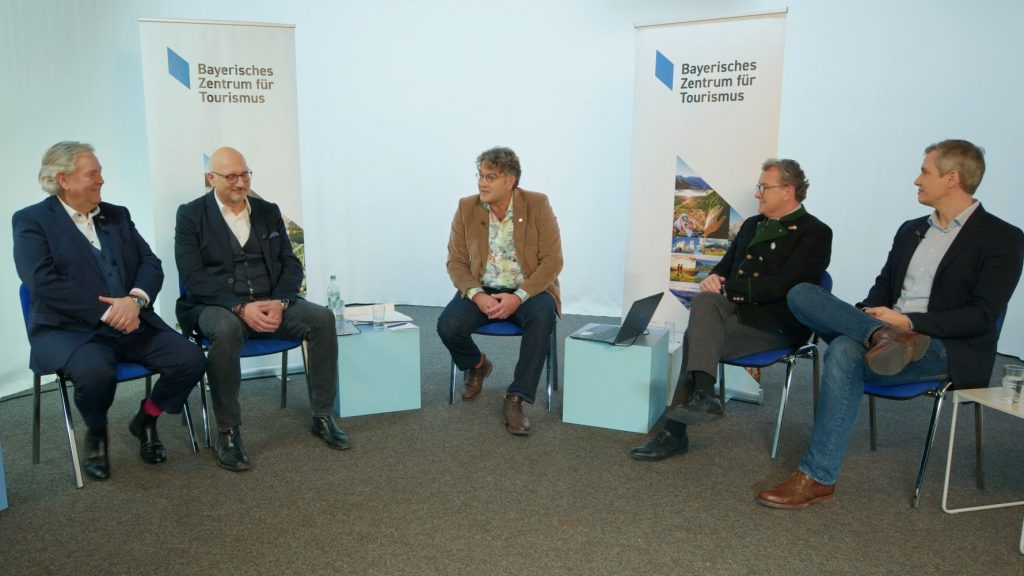
ONLINE-FORUM
Klimawandel und Tourismuspolitik
live am 06. Dezember 2022 I 10.00 bis 11.30 Uhr
ONLINE-FORUM
live am 06. Dezember 2022 I 10.00 bis 11.30 Uhr

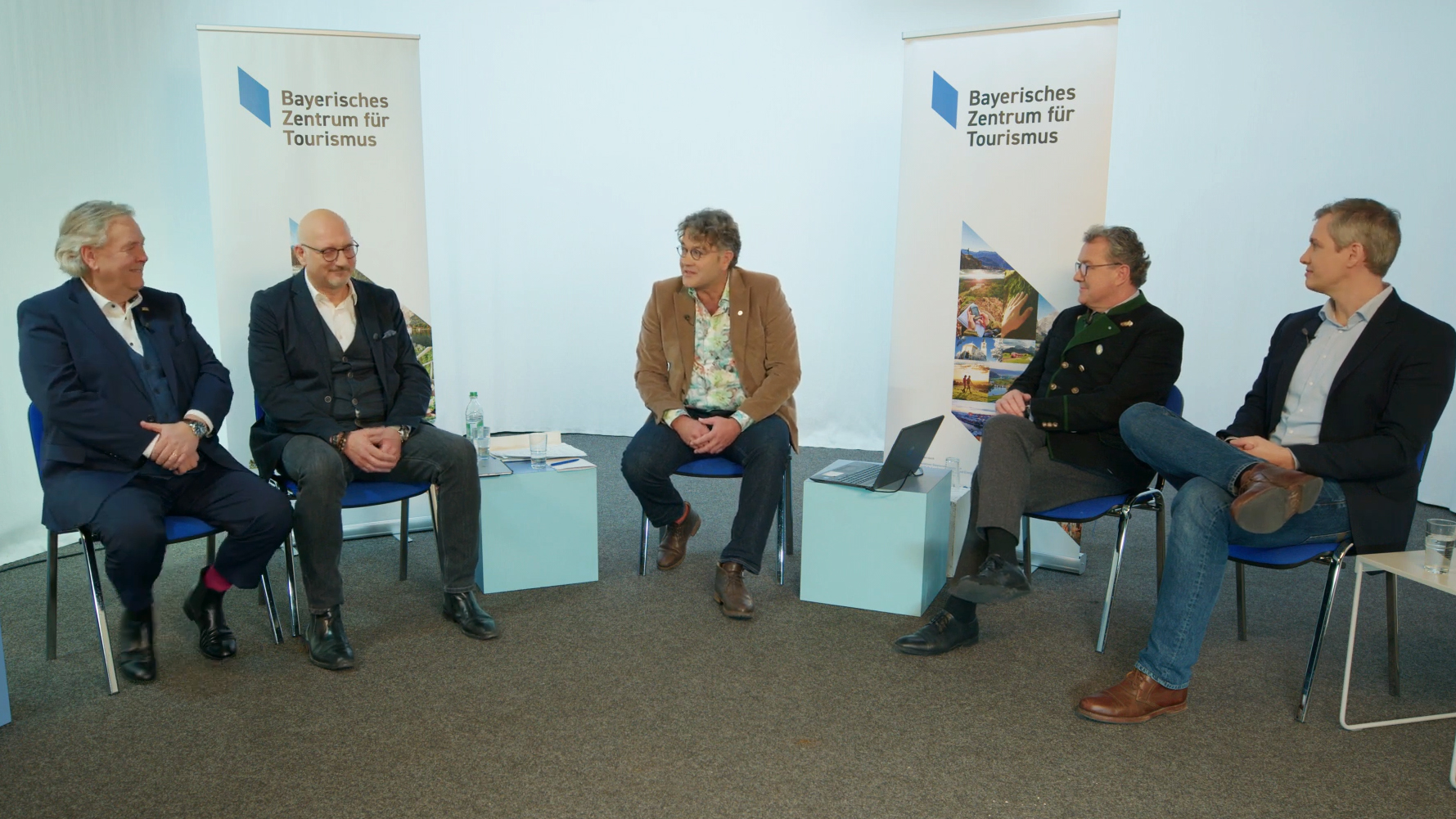
Albert Duin (FDP), Manfred Eibl (Freie Wähler), Dr. Georg Bayerle (Bayerischer Rundfunk), Klaus Stöttner (CSU), Christian Zwanziger (BÜNDNIS 90/DIE GRÜNEN) (v.l.n.r)

Mehr Struktur und Klarheit im „Förderdschungel“ der Klimawandel-Aktivitäten schaffen und die touristische Vielfalt Bayerns erhalten: Auf diese Ziele verständigten sich die tourismuspolitischen Sprecher der bayerischen Landtagsfraktionen in einer Diskussion zum Thema „Klimawandel und Tourismuspolitik“.

Mit dem Laden des Videos akzeptieren Sie die Datenschutzerklärung von YouTube.
Mehr erfahren
Im fünften Fachgespräch 2022 der BZT-Dialogreihe zu den „Folgen des Klimawandels für den Tourismus“, moderiert von Dr. Georg Bayerle vom Bayerischen Rundfunk, tauschten sich die Landespolitiker Albert Duin (FDP), Manfred Eibl (Freie Wähler), Klaus Stöttner (CSU) und Christian Zwanziger (BÜNDNIS 90/DIE GRÜNEN) in einer lebhaften und intensiven Diskussion zu den vielfältigen Klimaschutz-Aktionen vor allem auf regionaler Ebene im Freistaat aus.
Einleitend wurde Claudia Müller (MdB und Koordinatorin der Bundesregierung für die Maritime Wirtschaft und Tourismus, Bundesministerium für Wirtschaft und Klimaschutz) zugeschaltet, die in eindringlichen Worten die Bedeutung des Tourismus als wichtigen Eckpfeiler vor allem für die regionale Wirtschaft hervorhob. Zugleich thematisierte sie die Komplexität der aktuellen Förderprogramme in puncto Klimaschutz und definierte eine klare Zielsetzung hierfür: „Wir müssen Natur weiterhin erlebbar machen, und sie trotzdem schützen“, betonte die Bundespolitikerin.
In der anschließenden Diskussion unter den tourismuspolitischen Sprechern der bayerischen Landtagsfraktionen wurden die grundsätzlichen Linien in der Klimapolitik der einzelnen Parteien, die Auswirkungen von Energiekrise, Verkehr und Mobilität auf den Tourismus, aber auch die gesundheitlichen Aspekte des Klimawandels im Tourismus thematisiert.
Die Landespolitiker zeigten sich einig darin, dass sich im Freistaat bereits viele Tourismusregionen auf den Weg gemacht hätten, um auch bei der Problematik des Klimawandels und den damit einhergehenden Folgen neue Wege zu gehen. Begleitet von den politischen Förderprogrammen seien zahlreiche neue Mobilitätskonzepte entstanden. Sie müssten jedoch weiterhin modernisiert und noch stärker nach aktuellen Gesichtspunkten der Energieeffizienz gestaltet werden. Zudem gelte es den Aspekt der Nachhaltigkeit noch stärker bei der Genehmigung von Förderprogrammen zu berücksichtigen.
Besonders hervorgehoben wurde im Plenum die Bedeutung der kommunalen Selbstverwaltung bei Klimaschutz-Initiativen. Großes Lob erhielten die Kommunen für ihr Bemühen, die touristische Ursprünglichkeit der einzelnen Regionen zu erhalten.
Der BZT-Vorsitzende Prof. Dr. Alfred Bauer verkündete zum Ende des fünften Jahresdialogs 2022 den Themenschwerpunkt für das kommende Jahr: Demnach wird das BZT seinen Fokus auf den Komplex „Nachhaltige Gestaltung des Alltags- und Urlaubsraums: Bedürfnisse von Einheimischen und Gästen“ legen. In der Online-Dialogreihe 2023 werden die Reisenden und Einheimischen in den Mittelpunkt gestellt.

Bayerisches Zentrum für Tourismus
We firmly believe that the internet should be available and accessible to anyone, and are committed to providing a website that is accessible to the widest possible audience, regardless of circumstance and ability.
To fulfill this, we aim to adhere as strictly as possible to the World Wide Web Consortium’s (W3C) Web Content Accessibility Guidelines 2.1 (WCAG 2.1) at the AA level. These guidelines explain how to make web content accessible to people with a wide array of disabilities. Complying with those guidelines helps us ensure that the website is accessible to all people: blind people, people with motor impairments, visual impairment, cognitive disabilities, and more.
This website utilizes various technologies that are meant to make it as accessible as possible at all times. We utilize an accessibility interface that allows persons with specific disabilities to adjust the website’s UI (user interface) and design it to their personal needs.
Additionally, the website utilizes an AI-based application that runs in the background and optimizes its accessibility level constantly. This application remediates the website’s HTML, adapts Its functionality and behavior for screen-readers used by the blind users, and for keyboard functions used by individuals with motor impairments.
If you’ve found a malfunction or have ideas for improvement, we’ll be happy to hear from you. You can reach out to the website’s operators by using the following email
Our website implements the ARIA attributes (Accessible Rich Internet Applications) technique, alongside various different behavioral changes, to ensure blind users visiting with screen-readers are able to read, comprehend, and enjoy the website’s functions. As soon as a user with a screen-reader enters your site, they immediately receive a prompt to enter the Screen-Reader Profile so they can browse and operate your site effectively. Here’s how our website covers some of the most important screen-reader requirements, alongside console screenshots of code examples:
Screen-reader optimization: we run a background process that learns the website’s components from top to bottom, to ensure ongoing compliance even when updating the website. In this process, we provide screen-readers with meaningful data using the ARIA set of attributes. For example, we provide accurate form labels; descriptions for actionable icons (social media icons, search icons, cart icons, etc.); validation guidance for form inputs; element roles such as buttons, menus, modal dialogues (popups), and others. Additionally, the background process scans all the website’s images and provides an accurate and meaningful image-object-recognition-based description as an ALT (alternate text) tag for images that are not described. It will also extract texts that are embedded within the image, using an OCR (optical character recognition) technology. To turn on screen-reader adjustments at any time, users need only to press the Alt+1 keyboard combination. Screen-reader users also get automatic announcements to turn the Screen-reader mode on as soon as they enter the website.
These adjustments are compatible with all popular screen readers, including JAWS and NVDA.
Keyboard navigation optimization: The background process also adjusts the website’s HTML, and adds various behaviors using JavaScript code to make the website operable by the keyboard. This includes the ability to navigate the website using the Tab and Shift+Tab keys, operate dropdowns with the arrow keys, close them with Esc, trigger buttons and links using the Enter key, navigate between radio and checkbox elements using the arrow keys, and fill them in with the Spacebar or Enter key.Additionally, keyboard users will find quick-navigation and content-skip menus, available at any time by clicking Alt+1, or as the first elements of the site while navigating with the keyboard. The background process also handles triggered popups by moving the keyboard focus towards them as soon as they appear, and not allow the focus drift outside it.
Users can also use shortcuts such as “M” (menus), “H” (headings), “F” (forms), “B” (buttons), and “G” (graphics) to jump to specific elements.
We aim to support the widest array of browsers and assistive technologies as possible, so our users can choose the best fitting tools for them, with as few limitations as possible. Therefore, we have worked very hard to be able to support all major systems that comprise over 95% of the user market share including Google Chrome, Mozilla Firefox, Apple Safari, Opera and Microsoft Edge, JAWS and NVDA (screen readers).
Despite our very best efforts to allow anybody to adjust the website to their needs. There may still be pages or sections that are not fully accessible, are in the process of becoming accessible, or are lacking an adequate technological solution to make them accessible. Still, we are continually improving our accessibility, adding, updating and improving its options and features, and developing and adopting new technologies. All this is meant to reach the optimal level of accessibility, following technological advancements. For any assistance, please reach out to