GEFÖRDERTES PROJEKT 2022/2023

Schlagworte: Tourismus- und Wohnimmobilienentwicklung, Regionalentwicklung
© iStock.com/hifografik
Was bisher vor allem in Städten wie Barcelona oder Amsterdam für Aufsehen gesorgt hat, ist mittlerweile auch in ländlich geprägten Regionen und Städten zu einem Phänomen geworden: der Konkurrenzkampf zwischen der touristischen Nutzung von Immobilien und die zunehmend schwieriger werdende Verfügbarkeit von ausreichend bezahlbarem Wohnraum für die lokale Bevölkerung. Dieser Konflikt lässt sich mittlerweile auch in Destinationen im bayerischen Alpenraum beobachten, wie die Untersuchungen in Garmisch-Partenkirchen, Oberstdorf und Berchtesgaden zeigen.
Einerseits stehen in den genannten Orten sowohl der einheimischen Bevölkerung als auch im Tourismus und anderen Branchen benötigten Arbeitskräften nur wenige (bezahlbare) Wohnimmobilien zur Verfügung. Andererseits lässt sich eine deutliche (in jüngster Vergangenheit geradezu extreme) Erhöhung der Kosten für den Bau und Erwerb von Immobilien und (kaum mehr vorhandene) Grundstücke feststellen – und dabei kommen häufig ausschließlich finanzstarke externe Investoren zum Zuge. In dieser Situation stellen sich Fragen und Herausforderungen für eine zukunftsorientierte, sowohl an sozialen und (sozio)ökonomischen als auch ökologischen Kriterien ausgerichtete nachhaltige Kommunal- und Regionalentwicklung. Vor diesem Hintergrund beschäftigt sich die vorliegende Studie an den Beispielen von Oberstdorf und Berchtesgaden mit der Frage, welche rechtlich-regulativen und privatwirtschaftlichen Maßnahmen und Mittel den Gemeinden und den privaten Akteuren zur Verfügung stehen, um hier korrigierend eingreifen zu können und wie effektiv diese sind, um die Problemlage anzugehen.
Auffallend ist, dass sich die beteiligten Akteure (Verwaltung, Kommunalpolitik, Tourismussektor etc.) in unterschiedlicher Weise der Problematik bewusst sind – und damit auch verschiedene Strategien für deren Entschärfung entwickelt haben. Als zentral zur Problembewältigung haben sich die unterschiedlichen Instrumente der Raumplanung (Eingriffsmöglichkeiten bei bebautem bzw. unbebautem Boden) erwiesen, deren unterschiedlicher Einsatz untersucht (Limitationen, Effekte, etc.) und deren Erfolge in der Studie analysiert wurden. So entfalten Ansätze, wie beispielsweise die Soziale Bodennutzung oder das sogenannte „Berchtesgadener Modell“ (§22 BauGB, bez. Zweitwohnungsnutzungen) aber auch die Einführung sowie Erhöhung der Zweitwohnungssteuer durchaus Effekte in der jeweiligen gemeindlichen Entwicklung, ohne das Grundproblem jedoch vollständig lösen zu können.
Übersicht verschiedener Instrumente kommunaler Planung zur Regulierung des Bau- und Immobiliensektors
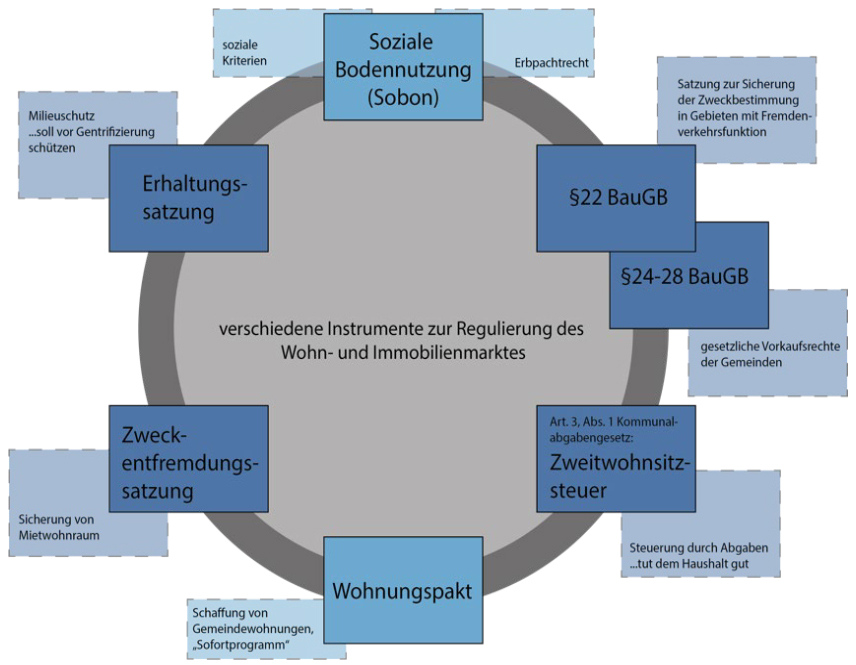
Quelle: eigene Abbildung nach Simon o.J., Interview 2023
Die Studie zeigt insofern, dass es insbesondere im rechtlich – regulativen Rahmen bedeutende Hemmnisse für eine sozial nachhaltige Raumentwicklung gibt, die kommunale Impulse für eine nachhaltigere regionale Entwicklung durch übergeordnete Rahmenbedingungen ausbremsen. Hieraus ergeben sich planerische Veränderungsbedarfe des Rechtsrahmens, um den Kommunen effektivere Handlungsoptionen an die Hand zu geben und so Gemeinde- und Tourismusentwicklung auch langfristig miteinander auszusöhnen.

Mit dem Laden des Videos akzeptieren Sie die Datenschutzerklärung von YouTube.
Mehr erfahren

Projektleitung: Prof. Dr. Christian Steiner (Katholische Universität Eichstätt-Ingolstadt)
Projektmitarbeit: Dr. Gerhard Rainer, Dr. Frank Zirkl, Msc. Theresa Kors


Bayerisches Zentrum für Tourismus
We firmly believe that the internet should be available and accessible to anyone, and are committed to providing a website that is accessible to the widest possible audience, regardless of circumstance and ability.
To fulfill this, we aim to adhere as strictly as possible to the World Wide Web Consortium’s (W3C) Web Content Accessibility Guidelines 2.1 (WCAG 2.1) at the AA level. These guidelines explain how to make web content accessible to people with a wide array of disabilities. Complying with those guidelines helps us ensure that the website is accessible to all people: blind people, people with motor impairments, visual impairment, cognitive disabilities, and more.
This website utilizes various technologies that are meant to make it as accessible as possible at all times. We utilize an accessibility interface that allows persons with specific disabilities to adjust the website’s UI (user interface) and design it to their personal needs.
Additionally, the website utilizes an AI-based application that runs in the background and optimizes its accessibility level constantly. This application remediates the website’s HTML, adapts Its functionality and behavior for screen-readers used by the blind users, and for keyboard functions used by individuals with motor impairments.
If you’ve found a malfunction or have ideas for improvement, we’ll be happy to hear from you. You can reach out to the website’s operators by using the following email
Our website implements the ARIA attributes (Accessible Rich Internet Applications) technique, alongside various different behavioral changes, to ensure blind users visiting with screen-readers are able to read, comprehend, and enjoy the website’s functions. As soon as a user with a screen-reader enters your site, they immediately receive a prompt to enter the Screen-Reader Profile so they can browse and operate your site effectively. Here’s how our website covers some of the most important screen-reader requirements, alongside console screenshots of code examples:
Screen-reader optimization: we run a background process that learns the website’s components from top to bottom, to ensure ongoing compliance even when updating the website. In this process, we provide screen-readers with meaningful data using the ARIA set of attributes. For example, we provide accurate form labels; descriptions for actionable icons (social media icons, search icons, cart icons, etc.); validation guidance for form inputs; element roles such as buttons, menus, modal dialogues (popups), and others. Additionally, the background process scans all the website’s images and provides an accurate and meaningful image-object-recognition-based description as an ALT (alternate text) tag for images that are not described. It will also extract texts that are embedded within the image, using an OCR (optical character recognition) technology. To turn on screen-reader adjustments at any time, users need only to press the Alt+1 keyboard combination. Screen-reader users also get automatic announcements to turn the Screen-reader mode on as soon as they enter the website.
These adjustments are compatible with all popular screen readers, including JAWS and NVDA.
Keyboard navigation optimization: The background process also adjusts the website’s HTML, and adds various behaviors using JavaScript code to make the website operable by the keyboard. This includes the ability to navigate the website using the Tab and Shift+Tab keys, operate dropdowns with the arrow keys, close them with Esc, trigger buttons and links using the Enter key, navigate between radio and checkbox elements using the arrow keys, and fill them in with the Spacebar or Enter key.Additionally, keyboard users will find quick-navigation and content-skip menus, available at any time by clicking Alt+1, or as the first elements of the site while navigating with the keyboard. The background process also handles triggered popups by moving the keyboard focus towards them as soon as they appear, and not allow the focus drift outside it.
Users can also use shortcuts such as “M” (menus), “H” (headings), “F” (forms), “B” (buttons), and “G” (graphics) to jump to specific elements.
We aim to support the widest array of browsers and assistive technologies as possible, so our users can choose the best fitting tools for them, with as few limitations as possible. Therefore, we have worked very hard to be able to support all major systems that comprise over 95% of the user market share including Google Chrome, Mozilla Firefox, Apple Safari, Opera and Microsoft Edge, JAWS and NVDA (screen readers).
Despite our very best efforts to allow anybody to adjust the website to their needs. There may still be pages or sections that are not fully accessible, are in the process of becoming accessible, or are lacking an adequate technological solution to make them accessible. Still, we are continually improving our accessibility, adding, updating and improving its options and features, and developing and adopting new technologies. All this is meant to reach the optimal level of accessibility, following technological advancements. For any assistance, please reach out to